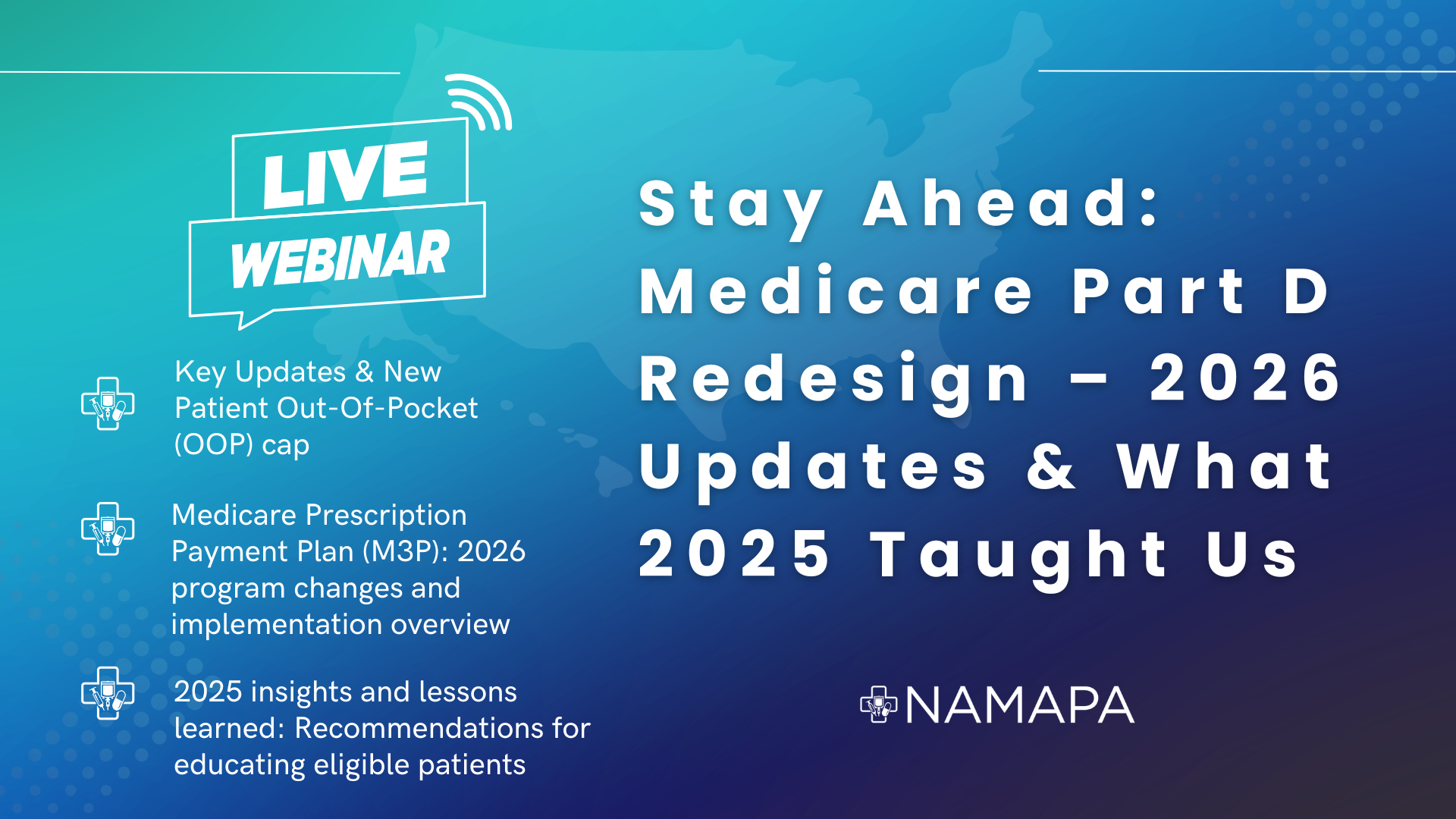
Stay Up to Date With Changes in Medicare Part D for 2026
Join the NAMAPA Webinar Series
The National Association of Medication Access & Patient Advocacy (NAMAPA) will host a webinar sponsored by Johnson & Johnson on changes in Medicare Part D for 2026 for professionals who support patient access, navigation, reimbursement, and advocacy.
Stay Ahead: Medicare Part D Redesign – 2026 Updates & What 2025 Taught Us
Join us for an insightful session designed to keep you informed and prepared for the upcoming Medicare Part D changes in 2026. We'll also reflect on the lessons learned from 2025—what worked, what didn’t, and recommendations that can help improve education regarding Part D Redesign and the Medicare Prescription Payment Plan.
What you'll learn:
Overview of Medicare Part D Redesign including the Patient Out of Pocket (OOP) cap
Overview of the Medicare Prescription Payment Plan (M3P) - Changes to Medicare Part D and the Medicare Prescription Payment Plan for 2026
Insights and lessons learned from 2025 with recommendations on how to educate patients likely to benefit
Don’t miss this opportunity to stay updated and ahead of the curve! Register now to secure your spot.
Additional Resources



DATA COLLECTION: This program is brought to you through a sponsorship between NAMAPA and Johnson & Johnson. Information that you provide when registering will be shared with NAMAPA (Host and account holder) and Johnson & Johnson (co-host) and can be used and shared by them in accordance with their applicable privacy policies. You may also receive follow-up communications from NAMAPA and/or Johnson & Johnson regarding Medicare Part D Redesign and other branded communications from Johnson & Johnson pertaining to its products and services. You can unsubscribe from these communications upon receipt. You can view Johnson & Johnson’s privacy policy here (https:// innovativemedicine.jnj.com/us/privacy-policy). You can also view NAMAPA’s privacy policy here (https://www.namapa.org/privacy-policy-consent-statement-and-terms-of-use)
Frequently Asked Questions on the Medicare Prescription Payment Plan
A Guide for Healthcare Professionals
-
Yes. The statutory Part D out-of-pocket (OOP) threshold is set for each calendar year and may be adjusted based on the annual percentage increase in average expenditures for covered Part D drugs in the United States for Part D eligible individuals in the previous year (API).
-
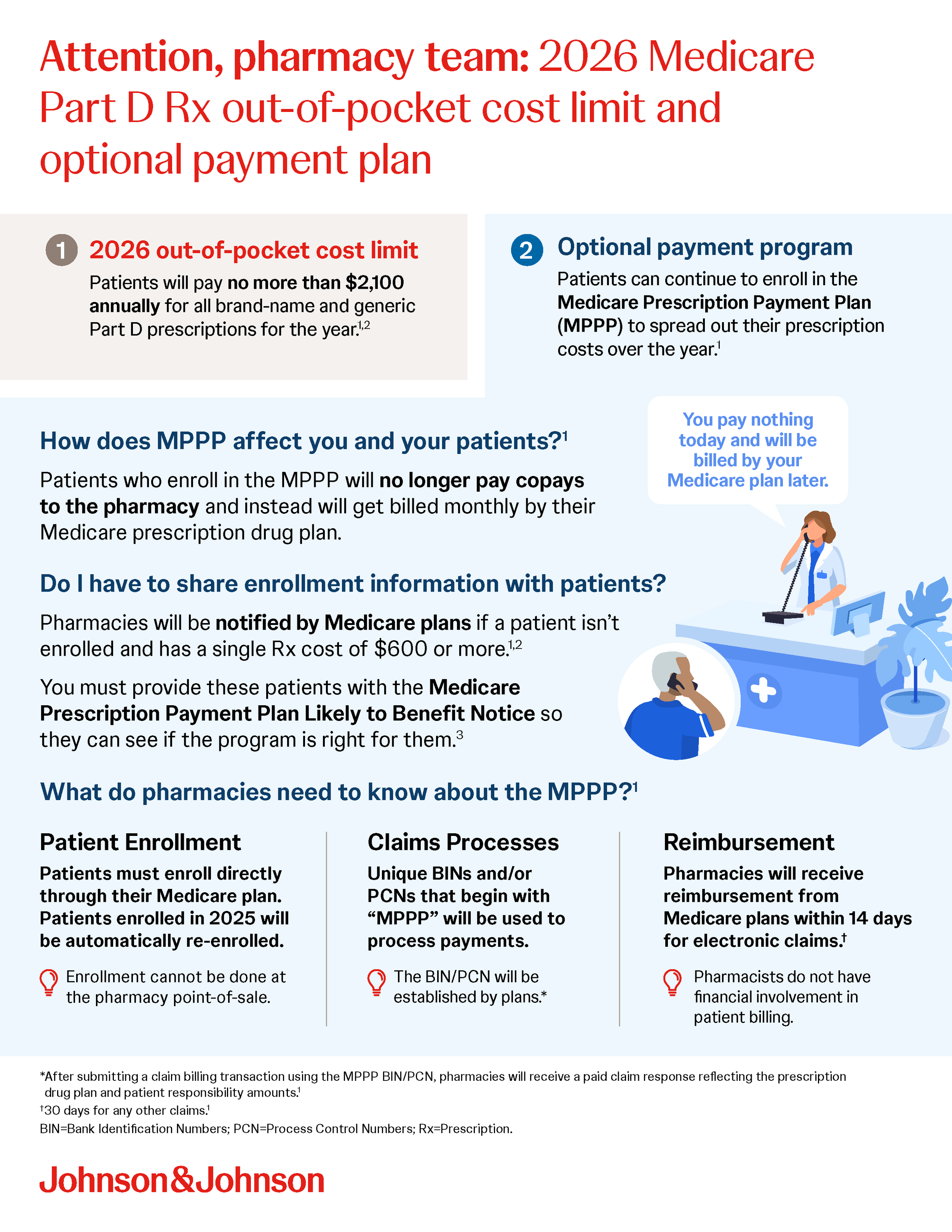
Yes, the 2026 $2,100 annual out-of-pocket threshold for Part D covered drugs includes amounts the patient pays toward the Part D deductible and cost-sharing. It does not include monthly plan premiums. (Medicare.gov; CMS).
-
If the patient had already met the annual out-of-pocket threshold, they should not owe additional patient cost-sharing for Part D covered drugs. If they had not met the threshold, they remain responsible for any outstanding patient cost-sharing. Part D Plan sponsors are required to provide itemized OOP costs by prescription, balances carried over from the prior month and missed payments, and plan contact information on invoices. This information can help to assess billing and payment status.
-
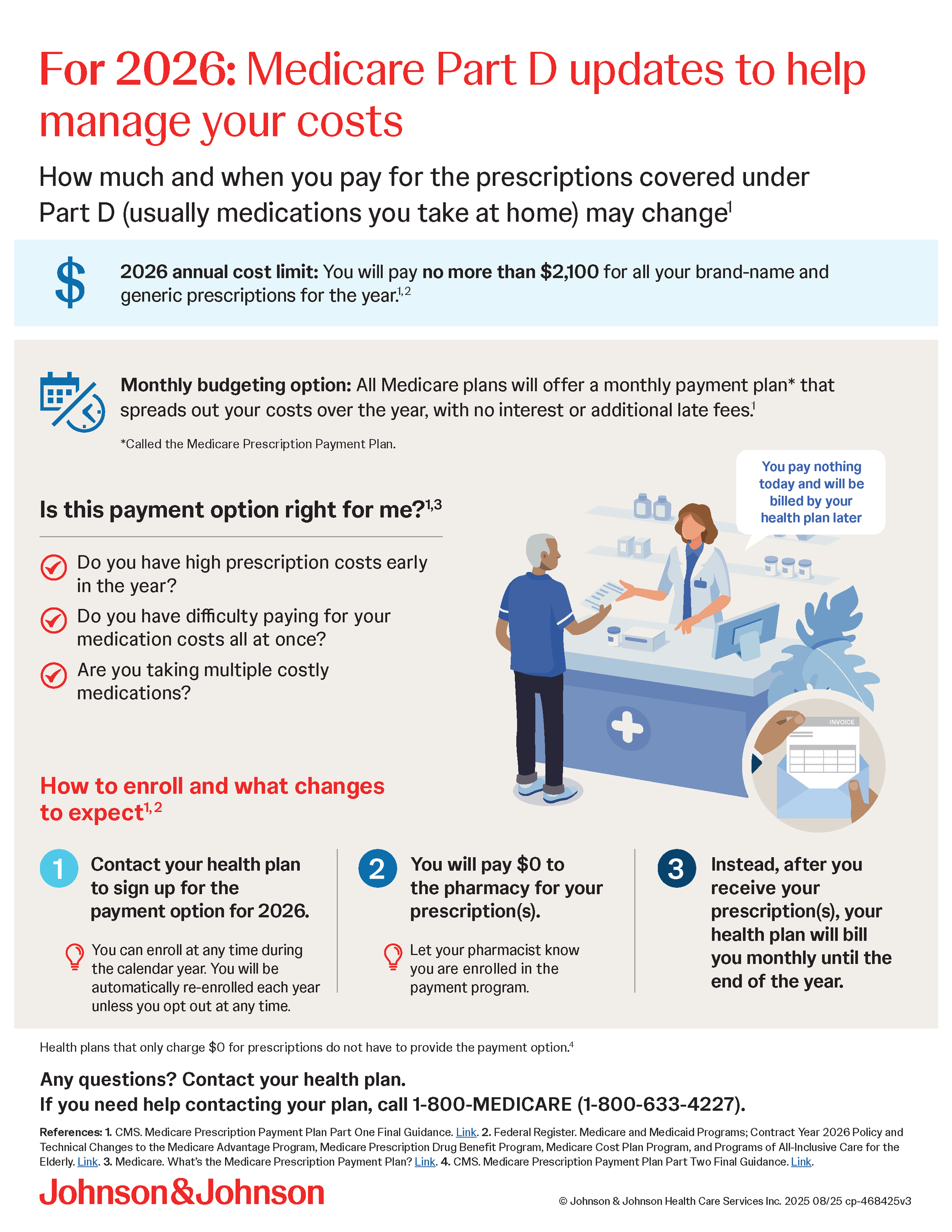
For 2026, CMS requires automatic re-enrollment of enrollees who remain in the same Part D plan from 2025 to 2026 (unless they opt out). This applies to Part D benefit plans, including Medicare Advantage plans with Part D coverage per CMS guidance. (CY2026 final rule / CMS MPPP guidance).
-
Patient payments for covered Part D drugs paid before MPPP enrollment count toward the annual out-of-pocket threshold. No beneficiary will pay more than the statutory cap for Part D covered drugs in the year. (Medicare.gov; CMS).
-
Yes. CMS guidance directs that charitable assistance should be applied first so the plan claim reflects patient liability net of charitable help. MPPP calculations then follow. For example, consider a patient who has an OOP expense of $2,100, and this patient also receives $1,000 in charitable assistance. The charitable assistance should be applied to the patient’s OOP expenses first, leaving a balance of $1,100. If the patient enrolls in MPPP, the $1,100 balance could then be split into smaller monthly payments (CMS MPPP Part Two guidance / FAQs).
-
It may benefit them. Other drug coverage may coordinate with Part D and affect point-of-sale costs and claim processing. Beneficiaries should report other coverage so their Part D sponsor can coordinate benefits.
-
No. The statutory Part D out-of-pocket cap (eg, $2,100 in 2026) applies to all Medicare Part D enrollees. MPPP is optional and only changes the timing/format of how the patient pays (installments).
-
Plans have been shifting some cost-sharing from fixed co-pays to coinsurance, and premiums continue to rise. This can increase patient liability, especially for high-cost medicines.
-
Partly. Extra Help (LIS) reduces or eliminates Part D cost-sharing for many low-income beneficiaries, reducing the need for MPPP for those individuals. However, low MPPP uptake also reflects limited awareness and operational barriers.
-
Yes. After the deductible, the plan’s normal cost-sharing (co-pay or coinsurance by formulary tier) applies. Those patient payments continue to count toward the annual out-of-pocket threshold, and MPPP only affects timing of payment, not total liability.
-
Pharmacies must provide a likely-to-benefit notice for high single-cost prescriptions. Patients must enroll in MPPP directly with their plan sponsor. Plans are required to process enrollments promptly so patients can obtain their medication soon after enrollment. Pharmacies may assist with contacting the plan, but the sponsor handles enrollment.
-
Yes. Drugs covered and billed under Medicare Part B are not part of the Part D benefit and are not counted toward the Part D out-of-pocket threshold or MPPP calculations. description
-
In December 2025, the National Association of Medication Access & Patient Advocacy (NAMAPA) hosted a webinar, sponsored by Johnson & Johnson, on changes in Medicare Part D for 2026 for professionals who support patient access, navigation, reimbursement, and advocacy. The questions included in this Frequently Asked Questions (FAQ) document represent questions posed and addressed during that webinar. please visit
-
This Frequently Asked Questions (FAQ) document is for informational purposes only and does not constitute medical, legal, or inancial advice. It is not intended to promote or advocate for any Medicare Prescription Payment Plan (MPPP) nor to direct readers to any specific patient assistance program. The findings summarized herein reflect information from publicly available publications, advisory boards, and other sources as of the date of publication. The authors do not endorse any particular plan or program, and the responsibility for interpreting and applying the material lies with the reader. If you have questions about plan options or eligibility, please consult official Centers for Medicare and Medicaid Services (CMS) resources or a licensed professional. No liabilities are assumed for errors or omissions.
-
1Centers for Medicare & Medicaid Services. Final CY 2026 Part D Redesign Program Instructions Fact Sheet.
CMS; April 7, 2025. Accessed February 26, 2025. https://www.cms.gov
2 Centers for Medicare & Medicaid Services. What’s the Medicare Prescription Payment Plan? CMS;
September 2025. Accessed February 26, 2026. https://www.medicare.gov
3 Centers for Medicare & Medicaid Services. Medicare Prescription Payment Plan: Final Part One Guidance on
Select Topics, Implementation of Section 1860D-2 of the Social Security Act for 2025, and Response to
Relevant Comments. CMS; February 29, 2024. Accessed February 26, 2026. https://www.cms.gov
4 Federal Register. Medicare and Medicaid Programs; Contract Year 2026 Policy and Technical Changes to the
Medicare Advantage Program, Medicare Prescription Drug Benefit Program, Medicare Cost Plan Program, and
Programs of All-Inclusive Care for the Elderly. Published April 15, 2025. Accessed February 26, 2026.
https://www.federalregister.gov
5 Centers for Medicare & Medicaid Services. Medicare Prescription Payment Plan: Final Part Two Guidance.
CMS; 2024. Accessed February 26, 2026. https://www.cms.gov
6 Centers for Medicare & Medicaid Services. Medicare and You 2026. CMS; 2026. Accessed February 26,
2026. https://www.medicare.gov
7 Trish E, Blaylock B, Van Nuys K. Cost sharing for preferred branded drugs in Medicare Part D. JAMA. 2025.
doi:10.1001/jama.2024.28092
8 Centers for Medicare & Medicaid Services. Medicare’s Extra Help Program. CMS; September 2025.
Accessed February 26, 2026. https://www.medicare.gov
9 Avalere Health. Early Enrollment Data Indicates More Beneficiaries Could Benefit From the Medicare
Prescription Payment Plan. Avalere Health Advisory; April 2025. Accessed March 9, 2026.
10 Centers for Medicare & Medicaid Services. Fact Sheet: Medicare Prescription Payment Plan. CMS; August
2023. Accessed March 9, 2026. https://www.cms.gov
Download the Full FAQ’s including background, disclaimer and references.
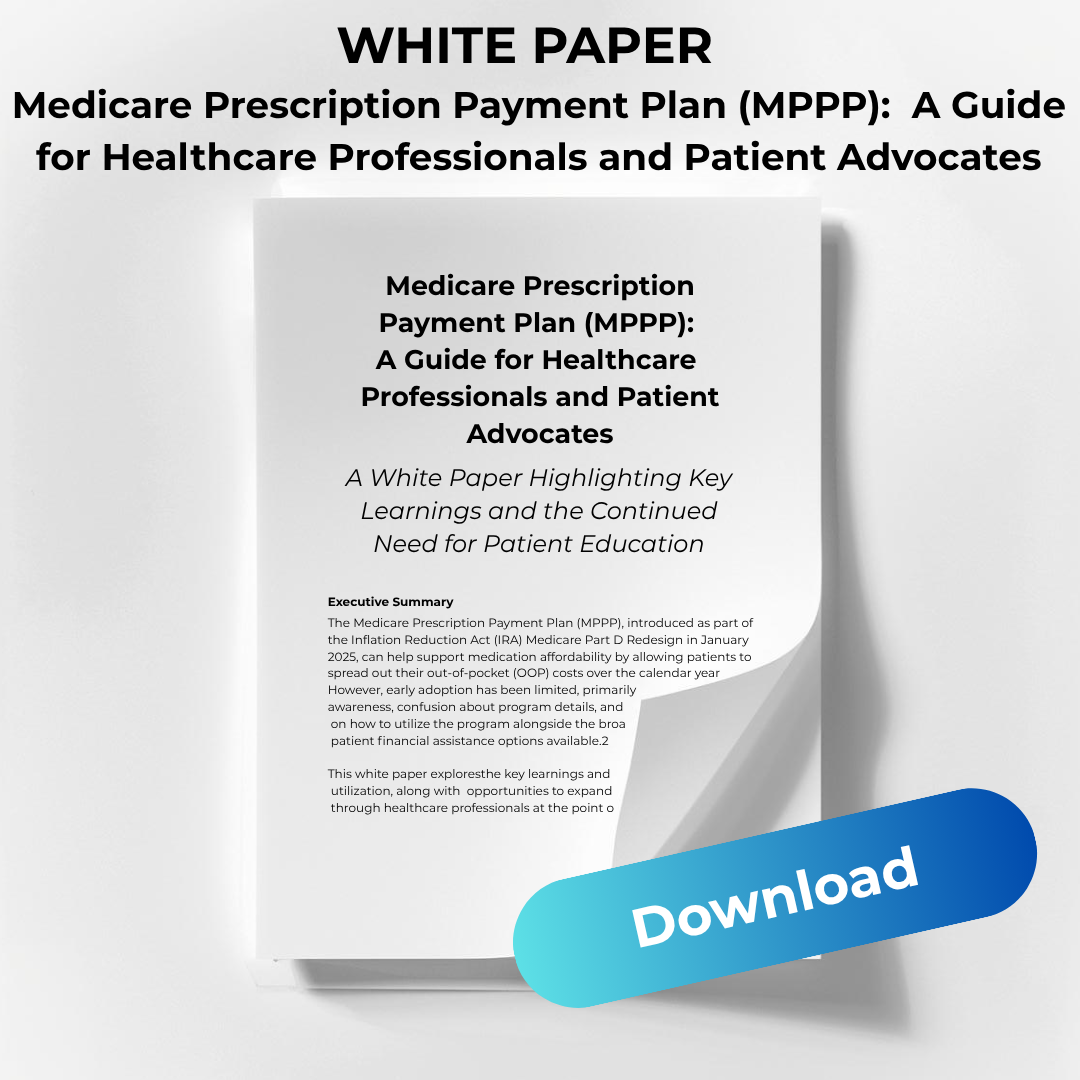
Complete the form below to download the White Paper: